There are 3 main groups of optical telescopes - refractors (the oldest type, as used by Sir Isaac Newton), reflectors, and catadioptrics. (For more detail see
this excellent wikipedia page). The SCT is one of the latter types, and I chose this because of the size and aperture. Basically, the greater the aperture (light gathering ability), the greater the number of objects that can be seen. I went for an 8 inch based on a simple price to performance equation: this is how much I wanted to pay, and this is the performance I got. For the same aperture, refractors are vastly more expensive. The big downsides to getting a larger scope (apart from cost obviously) are portability, size, and attachments - the bigger your scope, the bigger the other attachments (eyepieces, filters, etc.) seem to need to be (at least to compliment the scope, or to not become the limiting factor in its use), and consequently the greater the cost. The 8 inch version was a happy medium for me - 6 inches seemed too small - I felt like I could have picked it up and run with it, and worried I would regret not getting something bigger, but the 9.25 and 12 inch versions induced mumblings of, "what a beast" "where will I hide that from the wife - I couldn't even get it in the garden shed". So the 203mm C8 was a compromise of reasonable aperture, performance, portability, and cost. It still feels like a good price to me, and is probably why Celestron have sold so many of these pieces of kit. They are really popular, and I can see why.

Would I buy it again? Maybe. I'm still relatively new to this, and the only other scope I've really looked through is a cheap 80mm refractor (pictured above attached to my C8, which I'm using as a guide scope), so I haven't got much to compare, or got the best out of it yet, but so far it's been money well spent, and the optical tube is certainly fantastic; the detail I saw on the moon in the first week was gobsmacking. Yes, I literally spent a week looking at the moon awestruck.
Seeing Saturn and rings with your own eyes for the first time is also a memorable experience. More distant, smaller or fainter objects ("faint fuzzies") take more skill, such as good polar alignment and
averted vision, to get the best out of the scope, and you own eyes, but the C8 delivers in spades if you give it time to learn it's nuances.
The mount (CG-5) I have my doubts about - more on that later, but suffice it to say that for Goto functionality (slewing to objects in the database) it's great, but for long exposure astrophotography, you will be battling the mount, as much as all the other things that have to be just right.
I read a huge amount before shelling out my hard-earned on the scope, and one of the best sources of information I came across was
this site by Ted Kurkowski. Some of the content (for example on models, software and technology) is quite dated, but the guys knowledge and experience shines through. One of the great tips I picked up was to cut a disk with a hole over it and place it over the focuser, to enable finer control of focussing - always a tricky thing, especially with the standard focus knobs supplied on most scopes, and especially the C8. I cut a hole in an old plastic credit card sized rectangle (it was in fact a National Trust Membership card) and slotted it over the focussing knob. Not only was fine control much better, but it also reduced vibrations induced by touching the scope.
The first few accessories I bought were a moon filter (good for viewing when the moon is near full) and a Neodyniun "light pollition" filter (don't bother).
Next was adapting an old webcam I had lying around to enable me to take stills and video of the moon. Then USB cables to connect the mount to my laptop, so I could control it whilst sitting at my kitchen table, and not have to be out in the cold. When it was minus 6 degrees every night, this became a neccessty...
After about 6 weeks of being a telescope owner, I went a bit mad and spent the same amount as I had on the scope and mount, on a focal reducer, guide scope, guide camera, and CCD camera. Yes, I had really caught the bug, and my bank statements are the proof. But if I wanted to take long exposure shots, I need a camera that could do this, and the focal reducer to increase the speed (and reduce the f number from f/10 to f/6.3, and reduce the focal length (from approximately 2000mm to 1400mm), thereby reducing the required exposure time by a factor of 3. For long exposures I also needed a guide scope and camera to keep the telescope tracking my target objects.
Looks neat doesn't it?
Note the above picture includes the Celestron C8, with 80mm Skywatcher piggybacked on top as a guide scope (without eyepiece or camera attached). The red cap on the end of the C8 covers the focal reducer and extender - it is here the CCD camera goes. Just the other side of the focal reducer is the focusser (it was a standard focussing knob, but I replaced it with a feathertouch focuser and stepper motor). The above picture also does not conain cameras or the plethora of cables requires to power and operate the mount, focussing and cameras.

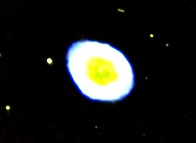 Having stacked the image I decided to crop it very close to the centre, and then played about more with the deconvolution settings in MaximDL. It brings out a little more detail and contrast in the (relatively) hot centre of the nebula, and the cooler outer regions, but as this is a raw single-shot colour based image with only a light pollution filter, not much detail of the nebula comes through. Can't wait to start using hydrogen-alpha and combining that data, but the telescope and camera are not suited to such small objects - the resolution falls off a cliff when zoomed in to this level. However, given the time of year, weather, and other limiting factors, I have had no choice but to image objects that are unsuitable for my set up. It is a good learning experience though...


