Showing posts with label QHY8L. Show all posts

Monday, 16 May 2011

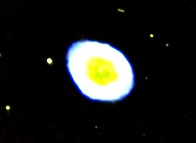
M57 - The Ring Nebula, 3x120 second

From about 8 frames captured, only 3 were worthy of stacking - I have found being very discriminatory with the calibrated images really does improve the end result. This image is unprocessed, but saving it as jpeg does not look good.  I have still to collimate the telescope, and this is also before I cleaned the optics yesterday.  Deconvolution does not work well on wide-field images such as this.  It's much better at bring out detail in nebula, galaxies, and other finer structures.


Having stacked the image I decided to crop it very close to the centre, and then played about more with the deconvolution settings in MaximDL.  It brings out a little more detail and contrast in the (relatively) hot centre of the nebula, and the cooler outer regions, but as this is a raw single-shot colour based image with only a light pollution filter, not much detail of the nebula comes through.  Can't wait to start using hydrogen-alpha and combining that data, but the telescope and camera are not suited to such small objects - the resolution falls off a cliff when zoomed in to this level.  However, given the time of year, weather, and other limiting factors, I have had no choice but to image objects that are unsuitable for my set up.  It is a good learning experience though...

For a much better idea of what I could be producing if someone gave me half a billion dollars, or a few hours with the HST, see here.

Sunday, 15 May 2011

M56 with C8, 9x100s, Calibration, Stack and Process

M56 is a globular cluster of magnitude 8.3 in the constellation of Lyra.  It's about 33,000 light years distant.  This is compared a magnitude of 5.9 for M13, that I have imaged a few times before, hence the greater difficulty in getting quality data. I had to reprocess multiple times as the flat frames didn't get rid of the dust donuts on the optics. They are still visible, which means my optics must be filthy.  This was probably all picked up during my excursion to Worcestershire a couple of weeks ago. I'm still not very happy with the result, but there was more mist in the air than was visible when capturing, and this drastically reduced the number of images available to stack.  This image is composed of 9 x 100 seconds exposures.  Out of a total of 37 subs, having only 9 barely usable ones is a bit disappointing - there were also many that were out of focus at the edges.  This is partly due to the big drop in temperature during the data capture (although I did auto-focus with FocusMax beforehand), and compounded by the fact the telescope needs collimating. I cropped and stretched the data in MaximDL, and then adjusted levels, curves, saturation, Gaussian blurred, and despeckled in Photoshop.

M56 Calibration Frames

Capturing calibration frames as planned.  Wow, did it get bright early!  At 3.50am the sky was blue in the east, which was too bright to continue imaging, so covered the scope and took dark frames.
Unfortunately I didn't buy the 250 quid Pink Floyd tickets I was offered....

Wednesday, 11 May 2011

Blooming CCD Camera

Computer says no blooming (after 300s)
While waiting for the clouds to clear, or the mist at least, I decided to see if I can make my CCD chip on the QHY8L bloom, which means over exposing the image so that electrons leak from the wells on the chip and drain off into other parts of the chip.  Apparently the QHY8L has anti-blooming - not sure how it works, but a 300s exposure of Arcturus might do the trick.
Lets try 600s.

This is pointless.  If the camera can't do 10 minute exposures of a bright star without blooming, then I have really bought a dud.  The guiding went AWOL during the exposure, so this will be interesting...  PHD (guiding) has gone off the scale again, so I've left the last minute to the mount to guide.
Not what I expected, little zig-zags...

M13, The Great Cluster in Hercules

I took 50 flat frames, and used the 6 darks taken last night, as well as 50 bias frames, and calibrated and stacked 16 images (each 60 second exposures), and combined them in MaximDL to get this image. No other processing.  The colour could be improved, as the data is there, but requires increasing the saturation.  This would bring out the blues and reds in the stars better.

Setting Up for Flats


C8 with cameras and cables (I always tidy the cables if I am going to image,  but with the clouds, it wasn't necessary)

The clouds have returned, as forecast, but I set up anyway as I needed to take some flats to enable calibration of the images I took yesterday of M13.  I took care not to change focus, or to turn the camera, or make any other changes to the telescope.  I have found the skyflats plugin for MaximDL written by John Winfield to be an excellent little tool for getting flats at dusk.  The plug-in automatically adjusts exposure length to compensate for the declining brightness of the sky so the average ADU of the flats are within the range required (approximately 25,000 ADU for my QHY8L).

 I also find sky flats better than the light box I built; probably something to do with the LED light source I used not having the right spectrum of light.
After the flats were taken, the sun lit up the clouds over south east London:
C8 at Sunset
I've left the telescope set up as there is a possibility that the clouds will clear at 11pm, and behind the strom front could be a window of opportunity... Until then I will process the shots of M13 I took last night.

Normal Guiding Service Resumed

A little less drift, but again, seeing conditions not ideal, so I am just happy to be imaging M13 again...

I've just noticed PHD was set to not guide on declination, so recalibrating with it set to north.
After getting enough data on M13, although it's late, M57 (the Rin Nebula in Lyra) came up into view, above the dirty grey zone of the horizon.  This is one of the joys of imaging where an image seemingly so bland as a grey smudge, will turn into a beautiful nebula once enough data is captured.  Yes, the grey smudge in the middle is what I am so excited about...

When I zoom in, this is what the camera is capturing, a planetary nebula 2,300 years from earth:

Once the image is processed, although it won't be nearly as good as the colour image below (from Stellarium), it's one of the personal rewards of astrophotography.

Below is one 120 second image converted to colour.  No other processing...

I wish I had more time to get more data, but as is often the case, M57 will have to wait for another day until I and my equipment can do it justice.

Apart from the odd blip, as below, (probably caused by "stiction" (static friction in the gears) - the CG-5 mount is reknowned for it), guiding has been good tonight, just a pity I have to close up shop...  The clouds are due to descend for a few days however, so at least I have plenty of data to process.


Monday, 9 May 2011

First Astrophoto


M3 Globular Cluster - 20 x 60s exposures taken with a C8 SCT. Darks and bias frames, but no flats

It's took me 6 weeks from getting my telescope in late January 2011, and a few weeks later a new QHY8L camera, to produce a reasonable astrophotograph.

During this time, I did a lot of reading about polar alignment, light pollution, exposures, guiding, set up, and all the other skills required for astronomy and astrophotography. I learnt it all from practically zero knowledge beforehand, and it has been a difficult but very rewarding experience.

It was only on Monday 7th March that the skies were clear enough in London for me to take 20 or so images of this globular cluster (M3), which I then processed and stacked in MaximDL.

Even 3 months ago I never would of thought I'd be taking images of globular clusters in the freezing cold March weather. It's an addicitive pastime that has grown on me very quickly.

More about my telescope and setup in the next post, but briefly:
Celestron 8 inch telescope - C8 SCT XLT on CG-5 Mount
f/6.3 reducer / Astronomik CLS-CCD filter / QHY8L camera
20 x 60s stacked in Maxim, curves and levels in Photoshop
Guided on PHD (although possibly not required on such short exposures if my polar alignment was any good!)

The main lesson I have learned, apart from the huge amount of patience required, is that you have to choose your target carefully, and then set up everything for the evening with this in mind.  For the first few nights out I often took few images of very many different objects, and for astrophotography this is absolutely no good, as a lot of data (images) are required to get the desired end result.  Images are processed and stacked to reduce noise and increase signal.